Saturday, August 17, 2013

God Is Disappointed in YouGod Is Disappointed in You by Mark Russell
My rating: 3 of 5 stars

First, I'd like to give this a 3.5 out of 5, but Goodreads still only allows whole integers for reviews.

Moving on: I picked up God is Disappointed in You at Comic Con this past July from one of my favorite publishers of non-superhero based comics, Top Shelf.  I like most of what Top Shelf puts out, and often buy new books blindly from the publisher because I can trust that their choices are sound.

This book, like most of their catalog, was pretty good, and I was not surprised to see it on their self (despite the presence of single panel, often tangential cartoons instead of an entire narrative told via comics).  It does what a lot of Top Shelf books do: sheds light on a serious (sacred, even) subject with a deft and witty hand.

The premise of the book is simple: retell the Bible, chapter by chapter, with no chapter being very long.  It was the concentrated, boiled down version of the book.  Mark Russell takes a nuanced approach to the job, breaking down the chapters, focusing on the important, central aspects of each chapter and presenting it in a clear, plain, often funny language.

Russell has a good voice, too.  I often and literally laughed out loud while reading the book, particularly during the early chapters of the Old Testament where things were really strange.  My favorite chapters also altered the delivery of the chapter from just a straight narrative to something more modern.  I think Leviticus was turned into an emailed memo.

The condensed and plain-spoken narrative helped to show the connections and shifts that happen between Genesis and Revelations.  I learned a lot about the Bible, and any claims of sacrilegiousness are really unfounded; Russell knows his Bible, but he is not afraid to laugh at some of the more absurd moments.

All of this said, I felt like the book became repetitive, especially towards the New Testament, where the narrative gets longer and more disjointed.  The premise of the narrative felt like a good trick that I kept seeing over and over again.  Eventually, I stopped being impressed by it.  And finally, I became numb to how expertly he was disseminating the text.

It might be a text that is better read in short bursts, like the Bible itself, rather than in a few prolonged sittings.  I often found myself thinking that this would have been one of the most shared blogs had he published it electronically first.

Another issue I had was with Shannon Wheeler's cartoons.  There were times the cartoons seemed to link up nicely with the narrative, and I then it seemed like the two were working in harmony.  Other times, especially in the New Testament, the cartoons seemed to try to be offensive, which is not the point of the book.  One cartoon in particular, where Jesus on the cross takes a phone call, was so incongruous that I found it distracting.  Several times I wondered what was the purpose of the cartoons?  The book stood alone without them, and rarely did they add anything to the text.

This is not to say that Wheeler was unfunny.  In fact, some of the cartoons were genuinely hilarious.  However, none of them were particularly necessary.

All in all, God is Disappointed in You is a good book and worth the cost.  It's funny, and I learned some about the Bible (which is nice).  However, I find that it works better as a book that is read in short, disconnected bursts, like Uncle John's Bathroom Reader.


View all my reviews

Monday, July 22, 2013

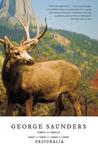
PastoraliaPastoralia by George Saunders
My rating: 3 of 5 stars

After reading a dense (albeit, a sometimes funny) book about the fundamentals of science, this George Saunders collection was like literary candy.

Like most of Saunders' work, the stories were genuinely very funny in a sort of bizarre way.  The first work in the collection was a novella in which the central characters are reenactors in a natural history museum.  The characters are meant to act like some sort of primitive version of mankind and are never allowed to break character.  Despite this very bizarre conceit, Saunders writes a touching tale in which a woman has a breakdown as her life falls apart around her, and how her coworker is left to deal with this.  It's a great examination of the mundanity of work life in the least mundane setting possible.

The thing about Saunders is that he can do that: filter the common and the everyday from the bizarre and unusual.  There is a universality to his work, all of it wrapped in a sugary package of prose.

That said, I liked this work less than other things I've read by him, namely The Brief and Frightening Reign of Phil. I was really hoping form something that blew my mind life the aforementioned book, but this one just left me flat towards the end.  While I wasn't quiet bored by this book, by the end I found I was struggling to get through the last few stories.

But, not a bad book by any means.  Even the stories in which I started to lose interest were readable and entertaining.


View all my reviews

Monday, June 17, 2013

The Canon: A Whirligig Tour of the Beautiful Basics of ScienceThe Canon: A Whirligig Tour of the Beautiful Basics of Science by Natalie Angier
My rating: 3 of 5 stars

 I am no scientist, but I like reading about science. I make for a difficult audience for science writers in that my understanding of all science is flawed, primarily theoretical, and wanes more than the moon (Who gave us the moon, indeed, Bill O'Reilly).

So, once again, I found an interesting looking book at the store with a title and book jacket description which piqued my interest. Angier's books promised to get me up to speed with all the developments in the scientific community, fostered by testimonial evidence culled from hundreds of interviews and other personal sources with which the writers was familiar.

At first, this is exactly what I got, and I really liked reading the alternating perspectives between a shifting mass of scientific voices and Angier. It was a clever way to assert one's own authority: aligning oneself with a multitude of expert voices by co-opting their ideas. The first two chapters on thinking scientifically and probabilities were actually quite good.

As the book progressed through the more hardcore science-y things (like physics, two types of chemistry and so on), the voices of the scientific community fell distant behind Angier's own understanding. At times, Angier was genuinely witty, and at times quite poetic. She seemed to favor clever word twists to drive home a point, and at times I was really impressed by this.

It was, however, a trick that became quickly played out. All the narrative flash was not enough to cover the fact that she all but stopped quoting other scientists in her book. By the end, I found myself getting quite annoyed with her obvious ploys to be clever.

Everything had to be so fucking clever.

By the end, I was drawn to the book far less than I was at the beginning, which is exactly the opposite reaction a novelist wants, particularly thriller and crime novelist who live on the tension of unresolved quarrels. The final chapter, on astronomy...one of my favorite pop science-y things to read about...took me forever to finish, because I was getting so tired of the puns and word-play to science reference ratio.

That said, if you don't know much about science, Angier is good at making common-sense connections between complex idea and layman's understandings. The beginning of the book is particularly good. For that, if nothing else, it's worth a look.


View all my reviews

Tuesday, March 12, 2013


This is a bit older, as I forgot to publish it before.

I Sailed with MagellanI Sailed with Magellan by Stuart Dybek
My rating: 4 of 5 stars

A few years back, I had the fortunate opportunity to have lunch with Stewart Dybek (though it's unlikely he'll remember it as much as I did).  He was quite delightful during the meal as we talked about his work, my past delusions of being a creative writer, and my current studies at SIU-C.

So, flash-forward several years, and I finally get around to reading I Sailed with Magellan, his follow-up to Chicago Stories, with which I was more familiar.  Regardless, my brief and pleasant encounter had not prepared me for the deep and profound sadness that threads through this collection of stories (a novel in stories, some would call it, but those people would be idiots).

This collection is more about a place than a person, though a young Polish Chicagoan, Perry, does tend to be in most of the stories, or one of his family members.  What these stories really give the reader is a taste of Chicago at a certain point in history.  More than other authors who use Chicago as the backdrop for their narratives (see: The Time Traveler's Wife, which was terrible), Dybek gets a sense of what Chicago looks like to a native.  There was more than just a parade of tourist locations; this took place in a neighborhood which was at one point filled with various European immigrants, but now has shifted.  This shift, this cultural and ethnic shift, is present in the narrative as much as the change that takes place in the characters.

Chicago, for Dybek, exists now only in memory.  And that, really, is the central point of the book: an exploration of the role of memory in narrative.  Most stories have very little present-day action.  For example, in the final story, Perry's brother Mick stands outside his old house, is asked one question several times, and then runs away (that's not really a spoiler).  The action that is in the present of the narrative is very, very limited.  Most of the story takes place as the narrator seamless drifts from present day observation to long recollection.  Connections are made between how the current situation and what past events lead to it.

It would be easy to label this stream-of-consciousness writing and lump it in with Woolf's Mrs. Dalloway, but there is something more here.  There is an overarching sadness at not only the events of the characters, but how the city remembers it's citizens.  Throughout the course of the novel, the characters change quite a bit, both internally (their personalities and characterizations) as well as externally (where they live and what they do), but the city remains mostly static.  Buildings seldom change purpose, and instead are left abandoned when emptied.  Houses fall down and never reappear.  It's a horribly sad reflection on how a city is merely a holding vessel for a constantly shifting mass of people who never stop to see it for what it is. In the same way that a glass will give shape to the water within, so to does Chicago give shape to the characters therein.  

I would strongly recommend this book to anyone.  There is just one warning: don't approach it as if it were a short story collection.  Approach it more like a novel about a city told in a varied, shifting perspective.  But not, under any circumstance, a novel-in-stories.


View all my reviews

My rating: 2 of 5 stars
I have a fondness in my heart for Palahniuk.  I loved Survivor and Choke, and I was fond of both Fight Club the book and the movie (which I thought was beter). I even liked Haunted, though I haven't looked at swimming pools the same since then.

That said, his taste for the bizarre and absurd results in his novels having a sort of "same-y" quality.  That is, a lot of his books start to read the same.  You can expect some visceral descriptions of bodily functions, some bizarre aspect of the character's lives hyperbolized, and a broken structure that bounces through time and space in burst of short sentences and paragraphs.

In Invisible Monsters, which I understand has been "remixed" and released with a less linear structure and more chapters, we get more of this.  The main characters are caricatures which don't fully actualize until late in the novel.  In fact, the twist, which Palahniuk over-uses more than M. Night Shamlamananahna (or however it's spelled), was both unsurprising and hardly emotive.  By the time I find out the shocking secret about Brandy and Shannon, I don't care.  The characters are entirely unrelatable and horrible people (which I know is the point), so when one dies in the very beginning of the novel, I never fully care that, when introduced to her earlier in her life, that she will end up dead.

Maybe that's the point: that underneath it all nothing is real and we are all horrible people.  There certainly is some truth to that, and Palahniuk does a good job showing what most people already know to be true: people, on average, will just try to kill everyone is left to their own devices.  And there is certainly some truth to the idea that nothing we see is real (to say any more would give away too much of the plot).  But even if that is true, the ending left me flat.  I didn't care.  I didn't buy the character's motivations.  I just felt "meh" at the end.

But the narrow end of this wedge of critical cheese is whether or not I would recommend reading the book.  If you liked Diary and Lullaby or are just a massive fan of Palahniuk's work (there are some fanatics out there), then yes.  Hope to it.  Otherwise, read Fight Club, Survivor, Choke and Haunted.  Those are better books.  


Monday, February 18, 2013

The Trouble with Zombies in The Walking Dead

Zombies are a great metaphor for ceaseless, senseless violence.  An expert in all things pop-cultural, Simon Pegg has an excellent introduction to Robert Kirkman's The Walking Dead Volume 1, in which he makes the case for the extreme metaphorical malleability of zombies.

Unlike other supernatural undead creatures in fantasy fiction, there is no clear consensus as to the properties of zombies.  Unless you are reading Stephanie Meyer, vampires are always pale night dwellers who drink human blood and can be defeated by a quick stab to the heart with a wooden stake.  They generally represent things like sexual desire, coming in through the windows at night and draining people of their innocence.  Zombie, though, are much simpler and thus more problematic as metaphors.  As the title of the above mentioned comic and TV show simply puts it: zombies are the walking dead.  Reanimated corpses that simply consume until their brains are completely destroyed.  

Beyond being dead and needing a brain, there is not much consensus as to what a zombie can do.  Some can run, some just stumble along; some have increased senses, some are essentially mindless killing machines; some are unnaturally strong, some can be wrestled down by an average man or woman.  And this is not necessarily across media, but within one work.  

For example, take arguably the most popular piece of zombie fiction, AMC's adaptation of Kirkman's The Walking Dead comic.  In the first season, some of the original camp has made their way to the top of a building in Atlanta (a department store, if I am not mistaken).  There are two sets of glass double doors between the Rick and company, and the horde of undead (and it is a horde) outside.  Eventually, the horde pushes through the doors and gains access to the building.  It's not shown exactly how they gain entrance, but it can be assumed they pushed hard enough to either crack the glass or to rip the door off it's hinges (or break the locks, though that seems less likely, since locks are meant to precisely not do that).  

Later in that same season, when T-Dogg (may God watch over his soul) dropped the keys to Merle's handcuffs, leaving him trapped on the roof, he barres the heavy metal door with a chain.  When the company returns to the roof to rescue Merle, the chain remains unbroken and the door on it's hinges.  Apparently, these doors are more difficult to break.  Or Merle, who cut his hand off, escaped before they could.  When T-Dog was explaining himself to Daryl, there was a note of concern as to how well the door would hold up.

In the second season, Lori flips her car when she madly searches for Rick, Glenn and Hershel.  While passed out, a couple of zombies find her trapped in the car and attempt to make a meal of her.  One finds a hole in the tempered glass of the windshield and pushes so forcefully against it that his face rips off and the glass starts to shatter further.  Again, this is not just any glass, but the treated glass used for windshields, which is meant to take quite a beating.  That the zombie has pushed through is fairly impressive, not just as a feat of strength, but also a sign of how determined they are to reach living flesh.  

In this season, what remains of the small groups has made their way to a prison.  Behind two chain link fences, the survivors can leave in relative safety from the walking horde of ever-consuming zombies that stumble around the edges.  This, though, is problematic: the zombies have shown that, as a horde, there are few things that can stop them.  Their hunger for flesh supersedes their pain tolerance (which as dead things, is remarkably high).  They will just push and push and push until they get where they want to go.  Especially if there is something tasty living thing to eat on the other end.  It would seem to me that the horde would bunch up at the entry point and the sheer mass of the zombies pushing against the fence (a chain link fence, mind you, which does not secure the doors deep into the ground) would cause it to break.  The glass of the department store and Lori's car window couldn't stand up to the walkers, but suddenly a chain link fence can?  As this video shows here, even the weight of one heavy set teenager who makes bad decisions in his life can bend the support posts of a fence.  The combined weight of several dozen zombies unceasingly pushing against a similar fence, even one fortified against outbreaks, would eventually bend.  

Also, in the prison, Rick and the other survivors manage to lock the fence using carabiners and chains (not particularly strong chains at that).  At one squeeze point in the prison, there is a sliding chain link fence (probably the weakest of the fencing options) held closed by just such a contraption.  Now, assuming they did find climbing grade carabiners in the zombie infested wasteland of Southern Georgia, these would be able to hold, for brief periods, around 21 kN or 4,725 lbs.  As this article from Boy's Life notes, though, carabiners are not made to withstand constant pressure and are more for safety sake, such as when rock climbing.  In the prison, these are as good as fortified steel doors, tightly padlocked shut.  

Which, then, is it?  Are zombies so focused on eating humans that they will literally walk through doors to get at anything alive?  Or can you simply hold them off with a good fence, some chain and some carabiners?  As metaphors, they certainly can still be useful.  What The Walking Dead needs to remember is what their zombies can do.  This is why the Twilight books upset so many vampire fans: they bucked convention when it complicated the plot.  That is, it would be hard for Bella to meet Edward in high school if he couldn't go outside in the day time.  In a similar vein, if a horde of zombies can push through anything, then they shouldn't be stopped simply by latching a gate shut.

Sunday, February 17, 2013


The White TrailThe White Trail by Fflur Dafydd
My rating: 4 of 5 stars

I bought this book for my sister as a Christmas present this past year.  I was studying in Wales at the time, and as I like to get books for her, I felt something particularly Welsh was a good fit.  That was really all I knew about it.  After she finished, she passed it along to me.

So, to say I was surprised is a bit of an understatement.  I really knew nothing of this book, this author, or the original story that it re-imagines.  What I found was a really engaging story by a really talented author.

The whole series, New Tales of the Mabigonion, is a collection of medieval Welsh fairy tales reshaped for a modern audience.  That is, the old characters are given a modern face-lift with new settings, new jobs and new(ish) stories.  Their core, however, was meant to remain the same.  The core of the story - the moral of the tale, if you will - remains the same.

What I was most impressed by was Dafydd's voice.  There is a poetry and ease of narration to the book.  Some of the descriptions are elegant and well-formulated, the word choice is immaculate, and the narrator easily slips and moves through time and space.  I felt like the narrator was genuinely concerned for the central character, Cilyiad, and that the narrator did a good job of showing the lost befuddlement which he seemed to walk through life covered in.  In short, the story was quite engaging and quite well-written.

I have two concerns: 1) The book had a lot of Welsh names in it which I was not really sure how to pronounce.  This is my own fault, mind (it's not the author's job to know that I can't read Welsh names), but a pronunciation guide would have been helpful.  I'm sure that, even to some native Welsh, Gwelw is a hard name to pronounce (and that was one of the shorter ones).  Yes, I get that the book was to be connected to the original tale and I am sure the names were left unmolested.  I understand that choice artistically; I just would have liked a little help is all.  2) The book was not very long, I found myself tearing through the book, due in part to the author's style and in larger part to the generous margins and spacing.  At £8.99 (or roughly $14), I felt like I was owed more to read.  With George R.R. Martin's Game of Thrones books, I was given over 800 pages for about $9.00 (¢1.125 per page).  It might have been nice for the publisher, Seren, to lump some of the books together and package them so that the reader gets more for the dollar (or pound, as the case may be).

In the end, though, I was neither too put off by the use of old, hard to pronounce names, nor the price per experience.  I was really pleased, pleasantly surprised even, by the book, and I would read more from this series and from Fflur Dafydd.


View all my reviews